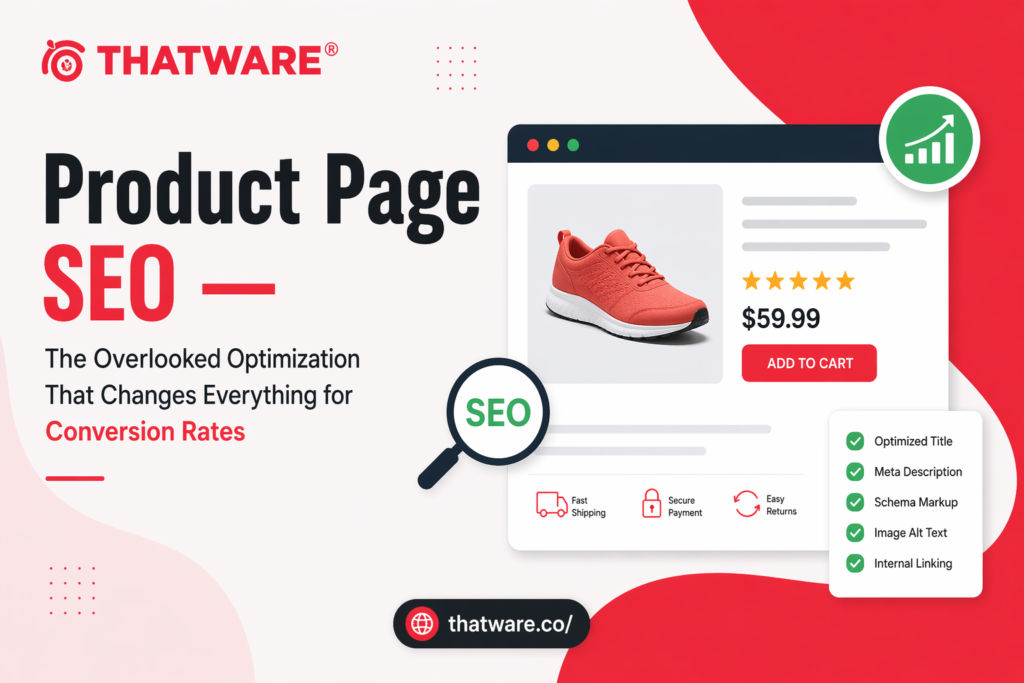
There’s a version of product page SEO that’s really just filling in a template – unique title tag, meta description, a few hundred words of copy, alt text on images. Check, check, check. And for a lot of e-commerce teams, that’s where product page optimization ends.
Which is exactly why it’s such a significant opportunity for brands willing to go further.
Product pages are doing double duty in a way that’s easy to underestimate. They’re not just landing pages for search traffic – they’re conversion environments. And the choices you make in optimizing them for search often directly affect whether the people who arrive actually buy. The two goals are more aligned than most teams realize, but unlocking that alignment requires a more complete understanding of what product pages actually need to do.
Why Most Product Pages Are Failing at Both Jobs
Think about the product pages you’ve landed on from a search. The average experience goes something like: a few product images, a title, a price, an “Add to Cart” button, and a block of text that reads like it was written by someone who had never used the product and was slightly bored.
That text usually exists because SEO requires unique, substantive content on product pages. So someone writes 200-350 words to satisfy that requirement, hits publish, and moves on. The content is technically there. It is not actually helping anyone decide whether to buy.
Here’s the problem with that approach: Google’s systems – and increasingly AI search systems – are getting better at evaluating whether content is genuinely useful to the person consuming it. Filler content written to satisfy a word count isn’t fooling anyone for long. And a page that has technically optimized metadata but thin, unconvincing content is leaving both search performance and conversion on the table.
What Actually Goes on a Product Page That Works
The most effective product pages do a specific job: they meet the customer wherever they are in their decision-making process and move them forward. That means anticipating the questions, doubts, and comparisons that are actually in someone’s head when they’re considering a purchase.
For most products, those questions are fairly predictable if you’ve talked to your customers or read your reviews. “Will this fit?” “How does it compare to [competitor product]?” “Is this worth the price compared to the cheaper option?” “What happens if it doesn’t work or I don’t like it?” “Who is actually using this and why?”
Content that directly addresses these questions – not generically, but specifically – converts better. Full stop. And it also tends to rank better, because it’s doing what good content does: genuinely serving the person reading it.
That’s the core insight behind product page seo done well. It’s not about gaming an algorithm. It’s about treating the product page as a genuine sales tool that happens to also need to be found.
The Technical Layer That Unlocks Search Performance
Good product page content is necessary but not sufficient. The technical SEO foundation matters enormously at scale – and most e-commerce sites have gaps here that are suppressing performance in ways the team isn’t aware of.
Schema markup for products is one of the most consistently underimplemented technical opportunities in e-commerce. Product schema – with price, availability, ratings, review count, and other attributes marked up correctly – enables rich results in Google search that dramatically improve click-through rates. A product listing with star ratings, price, and availability visible in the SERP gets clicked more than a plain listing, consistently. And yet a surprisingly large proportion of e-commerce sites either don’t implement product schema at all, or implement it incorrectly in ways that prevent rich results from triggering.
Page speed on product pages matters specifically. These are often the heaviest pages on an e-commerce site – high-resolution images, video, multiple third-party scripts (review widgets, sizing tools, chat), and sometimes complex JavaScript for interactive features. Every second of load time above two seconds is measurably reducing both search rankings and conversion rates. It’s one of the few optimization areas where the SEO and conversion benefit are perfectly aligned.
Internal linking from high-authority pages – like your homepage and category pages – to priority product pages is another consistently underutilized tool. Most e-commerce sites have a few products that matter most to the business, and structuring internal link equity to flow toward those pages is a straightforward technical lever that gets neglected.
Reviews as Both SEO Signal and Conversion Driver
Product reviews are one of the most powerful elements on a product page, and they’re doing multiple jobs simultaneously. For users, they’re the closest thing to a trusted recommendation available. For search, they’re fresh, unique content added automatically to product pages – which helps with the “unique content” challenge at scale. For AI search systems, review content is often a primary signal of social proof and real-world experience with a product.
The brands that actively work to generate reviews – with thoughtful post-purchase email sequences, reminder flows, and quality responses to existing reviews – are building a flywheel that pays dividends in search and conversion simultaneously. It’s one of the highest-ROI activities in ecommerce seo services, and it’s almost free to execute once the systems are in place.
Long-Tail Product Queries and the Intent Match Problem
One of the most common technical problems on product pages is intent mismatch. A product page might be ranking for a query that seems relevant but doesn’t actually match what the page delivers – and the user signals this by bouncing quickly, which feeds back negatively into rankings.
This happens most often when product pages rank for informational queries (“how to use X”) or comparison queries (“X vs Y”) rather than commercial ones. Addressing this usually means either creating separate content to properly handle those informational or comparison queries, or restructuring product page content to more directly serve commercial intent.
Getting intent alignment right – making sure product pages are optimized for queries where someone is actually ready to buy – is a foundational element of conversion-driven SEO. It’s not glamorous work. It requires careful keyword analysis and honest evaluation of what each page is actually delivering. But brands that do it consistently find that their traffic quality improves significantly, often without any increase in overall traffic volume. More buyers, fewer bounces. That’s worth a lot.