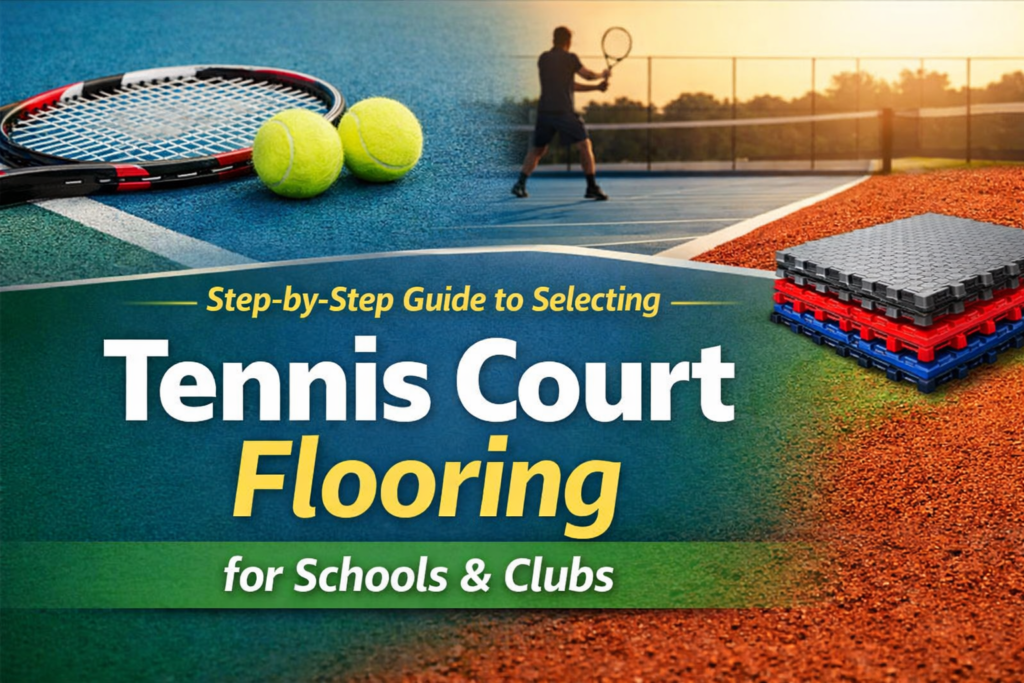
Selecting the right best tennis court flooring is a crucial decision for schools and clubs aiming to develop high-quality sports infrastructure. The right surface not only enhances gameplay but also ensures player safety, reduces maintenance costs, and increases the lifespan of the facility.
From understanding tennis court dimensions to comparing clay vs PP tiles vs acrylic surfaces and working with experienced tennis court builders, every factor plays a vital role. This comprehensive guide explains each step in detail to help make an informed and future-proof decision.
Understanding Tennis Court Flooring Options
Before starting any project, it is essential to understand the types of synthetic tennis court materials available in the market.
Acrylic Synthetic Tennis Court Flooring
Acrylic surfaces are the most widely used synthetic tennis court flooring system for schools and clubs. These courts are built using multiple layers of acrylic coatings applied over an asphalt or concrete base.
Key benefits include:
- Consistent ball bounce and medium-paced gameplay
- High durability in outdoor conditions
- UV resistance and weather protection
- Low maintenance requirements
PP Tiles (Modular Flooring)
PP tiles are interlocking tiles that are easy to install and suitable for temporary or multi-use courts.
However:
- They may expand or contract with temperature changes
- Surface consistency is not as smooth as acrylic
- Long-term durability can be lower compared to acrylic systems
Clay Courts
Clay courts are traditional and commonly used in professional tournaments.
Limitations include:
- High maintenance (watering, rolling, leveling)
- Not suitable for all weather conditions
- Higher operational costs over time
When comparing clay vs PP tiles vs acrylic, acrylic flooring stands out as the most practical solution for Indian schools and clubs due to its durability, performance, and cost-effectiveness.
Step 1: Understand Standard Tennis Court Dimensions
Proper knowledge of tennis court dimensions is essential before planning construction. Incorrect dimensions can affect gameplay and reduce the professional quality of the court.
Standard dimensions include:
- Total court length: 78 feet (23.77 meters)
- Singles court width: 27 feet (8.23 meters)
- Doubles court width: 36 feet (10.97 meters)
- Recommended total playing area: approximately 120 x 60 feet (including run-off space)
Correct layout planning ensures better player movement, safety, and compliance with international standards.
Step 2: Identify Usage Requirements
The intended use of the court plays a major role in selecting the right synthetic tennis court material.
For Schools:
- Heavy daily usage by students
- Need for multi-sport compatibility
- Focus on safety and low maintenance
For Clubs:
- Higher performance expectations
- Professional training sessions
- Better aesthetics and surface quality
Understanding usage helps in choosing a flooring system that balances durability and performance.
Step 3: Prioritize Player Safety and Comfort
Safety should always be a top priority, especially for schools where players are beginners or young athletes.
A high-quality synthetic tennis court flooring system should provide:
- Anti-slip surface to reduce fall risk
- Shock absorption to protect joints and muscles
- Uniform surface to prevent injuries
Acrylic flooring systems are designed with textured coatings that improve grip and playing comfort, making them suitable for both beginners and professionals.
Step 4: Compare Clay vs PP Tiles vs Acrylic in Detail
A deeper comparison helps clarify the best option:
| Feature | Clay | PP Tiles | Acrylic |
| Installation Cost | Medium | Low | Medium |
| Maintenance | Very High | Medium | Low |
| Durability | Moderate | Moderate | High |
| Weather Resistance | Low | Medium | High |
| Play Performance | Slow | Moderate | Balanced |
While clay courts offer a unique playing experience, they are not practical for schools. PP tiles offer convenience but lack long-term reliability. Acrylic remains the best choice for performance and maintenance balance.
Step 5: Consider Climate and Environmental Conditions
In countries like India, weather plays a significant role in court performance and longevity.
Important factors include:
- High UV exposure leading to surface fading
- Heavy rainfall requiring proper drainage
- Temperature fluctuations causing expansion and contraction
Modern synthetic tennis court materials are designed with UV-resistant and weatherproof coatings, ensuring long-lasting performance in outdoor environments.
Step 6: Focus on Base Construction and Drainage System
A tennis court is only as strong as its foundation. Proper base construction is critical for durability.
Key considerations:
- Use of asphalt or concrete base
- Proper slope (typically 1%) for water drainage
- Smooth and crack-free surface preparation
Poor base quality can lead to cracks, water accumulation, and surface failure,even if premium synthetic tennis court flooring is used.
Step 7: Choose Experienced Tennis Court Builders
Selecting professional tennis court builders is one of the most important steps in the process.
Experienced builders ensure:
- Accurate marking based on official tennis court dimensions
- Proper layering of synthetic coatings
- Use of high-quality materials
- Compliance with industry standards
Reliable contractors also help in selecting the right synthetic tennis court material based on site conditions and usage.
Step 8: Evaluate Cost vs Long-Term Value
Budget planning should go beyond initial installation costs. A complete cost analysis includes:
- Site preparation and base construction
- Surface material and installation
- Maintenance and resurfacing costs
While some options may seem affordable initially, acrylic synthetic tennis court flooring offers better long-term value due to:
- Lower maintenance expenses
- Longer lifespan
- Consistent performance over time
Step 9: Plan for Maintenance and Lifecycle Management
Even the best courts require regular maintenance to retain performance and appearance.
Maintenance practices include:
- Cleaning the surface regularly
- Removing debris and dust
- Inspecting for minor cracks
- Recoating every 4–6 years
Acrylic courts are known for their low maintenance needs, making them ideal for schools and clubs with limited resources.
Step 10: Consider Multi-Purpose Usage
Many schools and clubs prefer courts that can support multiple sports such as basketball, volleyball, or badminton.
Synthetic tennis court flooring, especially acrylic systems, can be customized with multi-line markings, allowing efficient use of space and higher return on investment.
Final Thoughts
Selecting the right tennis court flooring requires a strategic approach that balances performance, safety, durability, and cost. By understanding tennis court dimensions, evaluating clay vs PP tiles vs acrylic, and working with experienced tennis court builders, schools and clubs can develop world-class sports facilities.
Among all available options, synthetic tennis court flooring, particularly acrylic systems, stands out as the most reliable and future-ready solution. It offers excellent playability, long-term durability, and minimal maintenance, making it the preferred choice for modern sports infrastructure projects.